

Why does Korea seem to have so little Anglo-style small talk?
Some English-speaking visitors are caught off guard by how quiet everyday interactions in Korea can feel. It can happen after ordering in a shop, inside an elevator, when meeting someone for the first time at work or school, or after a brief exchange of help. You expect a weather comment, a quick joke, or a soft little line to keep the air warm, but the conversation ends as soon as the necessary words are done.
At first, that can make Korea feel a little cold. But the issue is often not warmth. It is the way relationships begin.
In Anglo contexts, small talk often opens the relationship
Anglo-style small talk does a lot of social work. It lowers awkwardness, softens the mood, and creates a safe first link between people who do not know each other yet. A few casual lines can signal friendliness before anything deeper is expected.
In that kind of culture, speech moves first. People talk a little in order to narrow the distance, and they learn who the other person is along the way. Small talk is not just filler. It is part of how contact becomes comfortable.
In Korea, people often read the relationship and the situation before they talk more
Korea often moves in the opposite order. Instead of extending the conversation right away, people tend to read who the other person is, what kind of situation this is, and how far the tone can naturally go. The words do not always loosen the atmosphere first. Quite often, the atmosphere has to settle before more words feel natural.
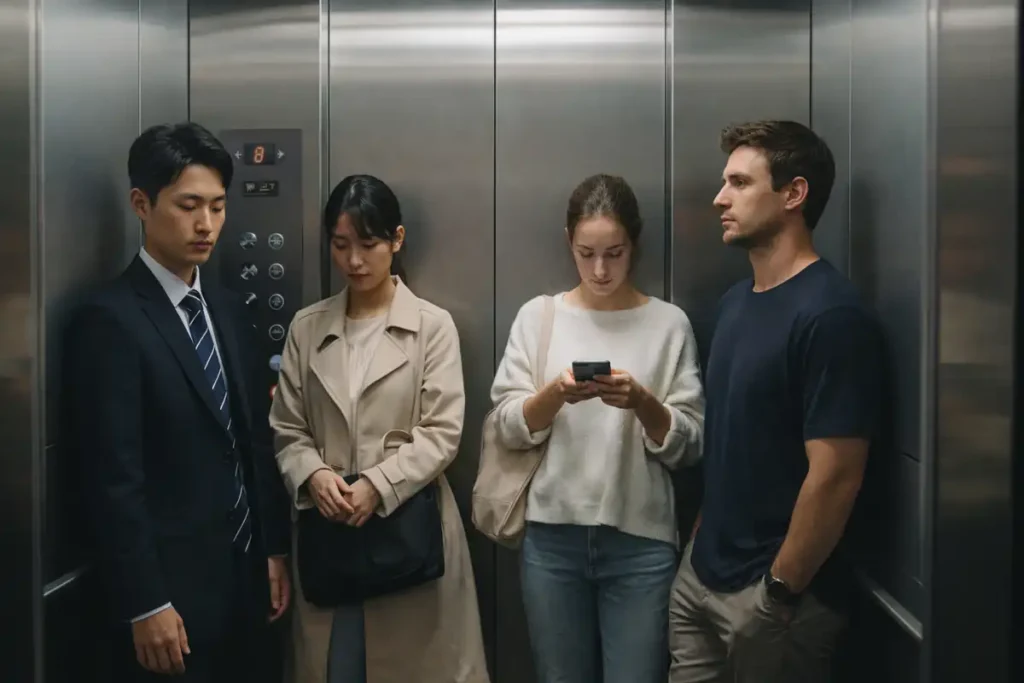
That is why an English-speaking visitor may feel the conversation stopped too soon, while a Korean person may feel there was simply nothing more that needed to be added.
This is tied to an older social rhythm
This is not only about individual personality. It also reflects how relationships were formed for a long time in Korean society. Korea spent centuries as a society where people were more likely to live within known circles shaped by region, family line, village, school, workplace, and repeated social contact. The details were always more complicated than that, but the basic social rhythm leaned less toward strangers connecting lightly as individuals and more toward people moving within relationships that had already been defined to some degree.
In that kind of environment, an outsider does not become an inside person right away. Not because they are disliked, but because the tone of the relationship has not been settled yet. How close is natural. How casual is natural. What kind of language fits. Those things often take time. Modern Korea is fully urban and modernized, but some of that older sense of distance still survives in the way people begin with each other.
This is where the idea of ‘uri’ matters
A useful word here is ‘uri,’ usually translated as ‘we’ or ‘our.’ In Korea, people often feel the world through the boundary of whether someone is inside ‘our side’ or not yet. Family, school, company, neighborhood, and close friend groups can all function as forms of ‘uri.’
That does not mean Koreans are always group-minded in a simple way. It means relationships are often felt first through belonging. In an Anglo setting, light conversation can help strangers connect before there is any real sense of shared belonging. In Korea, people may hesitate to move inward too quickly with someone who is not yet inside that circle.
Once someone moves inside, the relationship can change fast
This is where Korea can look completely different from the outside. The culture may seem slow to warm up at first, but once someone is no longer treated as fully outside, the relationship can become much more explicit. You can see that in forms of address. In Korea, people often call someone older ‘hyung,’ ‘nuna,’ ‘unni,’ or ‘oppa’ even when there is no family connection at all.
These are not just cute nicknames. They show that the person is no longer being kept at the level of a detached individual. The relationship is being placed inside a recognizable social shape. So Korea can look quiet at the entrance, then become much more direct once the relationship is allowed further in.
Observation often comes before questioning
You can hear this difference in the way conversations begin. Anglo small talk often opens with questions. How was your day. Where are you from. What do you think of the weather. The other person is invited straight into the exchange.
In Korea, it is often more natural to begin with an observation. It is hot today. It is raining a lot. There are so many people. Traffic was bad. You must have been busy. The point is not to pull the other person inward too quickly. It is to notice the same situation together first. That tends to feel lighter and less demanding.
Why the same moment can feel cold to one person and excessive to another
This is where the cultural misreading begins. A visitor from an Anglo background may feel that Korean interactions end too quickly and leave the air too dry. A Korean person may wonder why the moment needs extra words at all. Neither side is necessarily trying to be rude. They are simply starting from different ideas about what speech is supposed to do at the beginning of a relationship.
What looks like silence in Korea can carry caution, respect, and a reluctance to push into the other person’s space too early. It can also mean the situation matters more than the relationship in that particular moment.
When Koreans do get close, the conversation can deepen quickly
Another point that surprises visitors is how quickly Korean conversation can become personal after the relationship opens. The beginning may feel restrained, but later the talk can move into worries, feelings, private jokes, and direct personal comments much faster than an Anglo speaker expected. Instead of a long runway of casual talk, the shift can feel sudden.

That is why someone who says Korea has no small talk may only be seeing the stage before the relationship opens. The silence at the beginning is real, but it is not the whole rhythm.
For travelers, the important thing is not to read the silence too quickly
In shops, on public transport, in public spaces, and in short exchanges with strangers, expecting Anglo-style small talk can make Korea feel colder than it is. It is often easier to understand these moments by seeing that the situation is being organized first. The necessary words come first. Warmth may come later, or it may stay quiet and still not mean rejection.
That is why it helps not to read every brief interaction as indifference. Sometimes the conversation is short because the relationship has not been asked to do more yet.
Korea does not lack light conversation. It uses a different doorway
Korea is not a place without casual talk. What is different is that casual talk is not always the main tool for opening contact with someone new. Quite often, the relationship and the situation settle first. Then the words follow. And once someone is no longer outside, the language can change fast enough to give them a place inside ‘uri’ itself.
That is why Anglo-style small talk can feel less visible in Korea. It is not because Koreans dislike conversation. The doorway into conversation is simply different.